The Headline Verb That Quietly Changes a Claim
Headline verbs shape how readers interpret a claim. Learn to compare says, finds, shows, and admits with the source and keep each conclusion narrow.

You open a news alert over breakfast: “Agency admits records were missing.” The linked statement says the agency “identified gaps in its records.” Those phrases may describe related events, but admits implies a concession that the statement may not support. Checking headline verbs against their sources helps separate what happened from what the wording suggests.
Headline verb meanings
A headline verb describes the relationship between a source and a claim. Someone may have made a statement, an inquiry may have reached a conclusion, or a person may have acknowledged something. These are different kinds of information, even when they concern the same event.
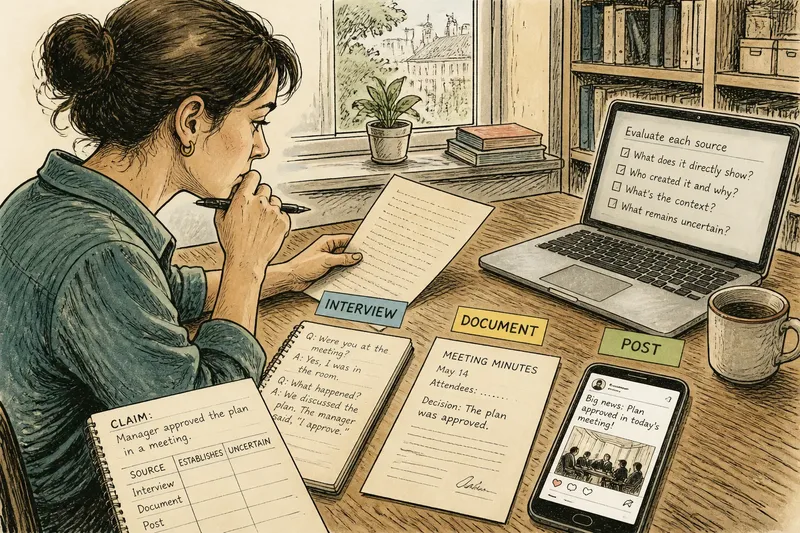
First identify the verb, then locate the passage, document, or recording behind it. Ask what the source says directly and what the headline adds through implication. The goal is not to strip headlines of vivid language; it is to check whether the evidence supports the particular relationship the verb conveys.
Statements and positions
Says attributes a statement to a person or organization. “The mayor says the bridge will reopen soon” reports the mayor’s prediction; it does not establish that the bridge will reopen.
Compare the headline with the original statement. Check that the named person made the claim and that the headline retains important conditions, such as “if inspections are complete.” A story can accurately report a statement while leaving its truth unresolved.
Claims also attributes an assertion, often with some distance from its accuracy or acceptance. “The company claims its product reduces waste” is not proof that the statement is false. Look for the article’s supporting evidence and any explanation of a dispute.
Argues usually introduces reasoning or a position. If a legal group argues that a rule violates a law, that is the group’s interpretation, not necessarily a court’s ruling. Check whether the headline attributes the position to the group or presents it as settled fact.
Findings and evidence
Finds generally describes a conclusion reached through an inquiry, analysis, audit, or report. “Audit finds errors in filing process” points to a result of examination, but the headline alone does not tell you what was examined.
Read the report’s conclusion and note its scope and limitations. If it discusses a sample of files, do not treat the finding as a claim about every file. Keep the conclusion within the boundaries the report itself sets.
Shows can make an inference sound directly observed. A document may show that a meeting occurred; it may not, by itself, show why participants met or what they intended. Separate what the material states or depicts from the article’s interpretation.
Suggests signals a tentative connection or interpretation. It can fit evidence that points toward a possibility without settling it. Look for the specific evidence in the story and identify what remains uncertain.
Acknowledgment and confirmation
Admits often implies that someone acknowledged something unfavorable, concealed, or disputed. A source saying “we found an error” may support “says an error occurred,” but it does not automatically support “admits fault.” Check whether the person accepted responsibility or only described an event.
Confirms suggests that information verifies a detail or agrees with something already reported. Ask exactly what was confirmed and by whom. A source may verify one narrow point without establishing the larger account around it.
Compare the source?
Does says mean a claim is unverified?
No. Says identifies who made a statement; it does not tell you whether anyone checked it. Look for evidence, qualification, and independent confirmation in the story.
Is claims always a sign of doubt?
No. Claims can signal distance or dispute, but its use depends on context. Check whether the article explains a disagreement or simply attributes an assertion.
Can a report find something without proving it?
A report can state a conclusion while leaving questions about its method, scope, or interpretation. Read what it examined and what it identifies as unresolved.
When is admits too strong?
It is too strong when the source reports or acknowledges an event without conceding wrongdoing or a disputed point. Compare the headline with the exact statement, not only the article’s paraphrase.
Choose a careful reading
- Observation: The headline says a person “says” something, and the source contains the same statement. If/then: If the wording matches, treat it as an attributed statement; if a condition is missing, include that condition in your reading.
- Observation: The headline says someone “claims” something, and the story describes a dispute. If/then: If the dispute is explained, keep the attribution and dispute together; if it is not explained, look for the basis before deciding what the label implies.
- Observation: The headline says a report “finds” a result, and the report names a limited scope. If/then: If the scope is narrow, keep the conclusion narrow; if the story generalizes beyond it, check the report before accepting that wider claim.
- Observation: The headline says evidence “shows” an event, but the material only records a related detail. If/then: If the detail is explicit, state that detail; if the headline adds an interpretation, distinguish the inference from the record.
- Observation: The headline says evidence “suggests” a possibility, and the article names the evidence. If/then: If the link remains tentative, retain that uncertainty; if the article gives no basis, do not treat the suggestion as established.
- Observation: The headline says someone “admits” an event, while the source only acknowledges it. If/then: If the source accepts responsibility, include that specific concession; if it does not, describe the acknowledgment without implying blame.
- Observation: The headline says a source “confirms” a broad account, while the source verifies one detail. If/then: If only the detail is verified, limit the claim to it; if the article says more is confirmed, check for a separate source supporting the broader statement.
Say you encounter an invented headline: “Transit office admits route change caused delays.” Its invented linked notice reads, “The office recognizes that changing the route disrupted some trips,” and an invented review says the full cause of delays has not been determined. Compare the headline with each source: the notice acknowledges disruption, while the review leaves causation unresolved. The resulting reading is narrower—the office recognized disruption, but the supplied material does not establish sole cause or an admission of fault.
Keep the claim narrow
When a headline verb feels loaded, restate the claim plainly: who said or concluded what, and on what basis? Then compare each part with the source. This is a practical way to distinguish an attributed claim from a conclusion the evidence supports.
For headline verbs, the useful question is not simply whether a word sounds neutral. Ask what relationship it asserts between the source and the statement, and stop where the source stops.