Interview, Document or Post: What Each Source Can Show
Learn what interviews, documents, and online posts can establish, what each leaves uncertain, and how to check a claim without overstating its evidence.
A reporter’s interview, a scanned letter, and a viral post can all appear in the same news story, but they do not establish the same things. To assess a claim, identify what kind of source supports it, what that source can directly show, and what would need separate confirmation.
This distinction matters when a story attributes a decision to a person, describes an event, or circulates a screenshot as proof. The useful question is not simply whether a source is trustworthy. Ask what it is evidence of—and where its reach ends.
Start with the claim
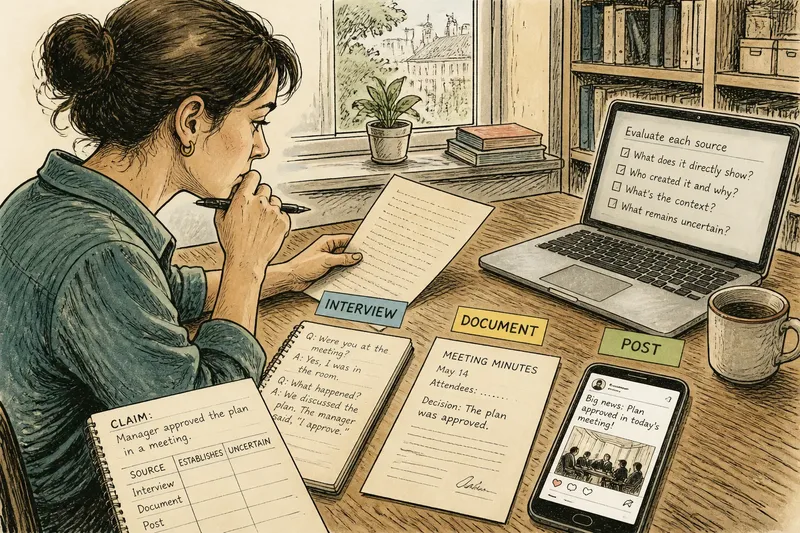
Before judging a source, rewrite the story’s central claim in plain language. Separate claims that may be bundled together. “A manager approved the plan in a meeting” includes a meeting, a decision, and the identity of the decision-maker. One source may support one part without establishing all three.
Then note the exact detail you need to verify: who was present, what was said, when a record was created, or whether a post appeared on a particular account. This keeps a vivid source from doing more work than it can support.
For each detail, distinguish direct observation from interpretation. A witness may have heard a sentence but not know what the speaker intended. A document may record an approval but not show whether the person who signed it understood every consequence.
Read an interview closely
An interview can establish what a person says they saw, heard, did, or understood. It may also provide context that a form or brief public statement leaves out. But recollection is not a recording: memory can be incomplete, and a speaker’s access to an event may be limited.
Check how close the person was to the event. Did they attend the meeting, hear about it afterward, or infer what happened from a later decision? Notice whether the account identifies a specific time, place, or action, and whether the speaker separates firsthand knowledge from what someone else told them.
Pay attention to the wording of the claim. “I was in the room when the vote happened” is a firsthand account of presence and a vote. It does not, by itself, establish why each person voted as they did or whether the meeting record is complete.
Compare the interview with independent material where available. A second person who was present may corroborate a detail; a document created during the event may help settle timing. Repetition by several people is not independent confirmation if they all rely on the same original account.
Inspect a written record
A written record can establish what its text says and, when its origin is clear, what an organization recorded or communicated. Examples include meeting minutes, a signed letter, a policy, a filing, or an email. It may preserve exact wording better than anyone’s later memory.
First identify the record’s source and purpose. Who created it, for whom, and in what setting? A draft prepared for discussion, approved minutes, and a public notice are different kinds of records. A document’s formal appearance does not answer whether it is final, complete, or authentic.
Read around the quoted passage. Look for a title, date, author or issuing office, version labels, and surrounding text that changes the meaning. A sentence copied from a longer memo might state a proposal rather than a decision. If the story relies on a screenshot, seek the full record or an official copy when possible.
A record can show what was written without proving that the stated events occurred exactly as described. A form may document an allegation, not verify it. Minutes may record a decision while omitting disagreement or discussion. Treat the document’s content and the events behind it as related but distinct claims.
Examine an online post
A post can show that particular words, images, or video were displayed by an account at a given point, if the account and capture are correctly identified. It can also reveal how someone publicly represented an event. It may not establish that the account owner created the material, that the post is complete, or that a caption accurately describes what an image depicts.
Check the original post rather than relying only on a cropped screenshot. Look at the account name, surrounding posts, visible date, links, and whether the post has been edited or deleted. Search for the image or video in other contexts: older material can be recirculated with a new description.
Separate what the media visibly contains from what its caption claims. A short clip may show a person entering a building, but not why they went there or what happened before recording began. A post quoting a document is not a substitute for seeing the document itself.
Say you encounter a post claiming that a school canceled an event after a safety complaint. The post itself may establish that the account made that claim. To establish the cancellation and its stated reason, you would look for the school’s notice, a full relevant record, or an interview with someone directly involved.
Match claims to sources?
What can an interview establish?
An interview can establish a person’s account and, with clear firsthand access, support claims about what they observed or did. It cannot alone settle every detail of an event or establish another person’s private motive.
What does a document prove?
A document can establish its wording and, if authenticated and properly attributed, what its creator recorded or communicated. It does not automatically prove that every statement inside it is true or that the record captures the full context.
What can a social post show?
A post can support a claim about what appeared on an account or what content was shared, once its origin and context are checked. It may not verify the underlying event, the account owner’s identity, or the accuracy of its caption.
How should conflicting sources be handled?
State which details each source supports and where they disagree, rather than choosing the most vivid account by default. Seek an additional source with a different route to the information, and keep unresolved points explicitly unresolved.
Build a careful account
Once you have assessed each source, connect it to a precise claim. A simple note can help: claim; supporting source; what that source directly establishes; what remains uncertain. Keep the note specific enough that another reader can see the boundary between evidence and inference.
If sources conflict, check whether they refer to the same time, place, version, or meaning of a word. An interviewee may recall a discussion while minutes record the formal vote. Those accounts can differ without one necessarily disproving the other.
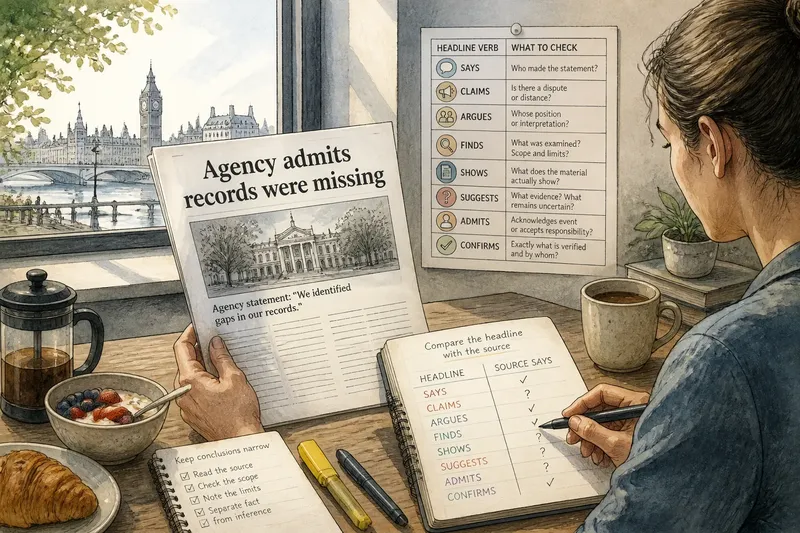
Use verbs that match the evidence. “The memo states,” “the witness recalled,” and “the account posted” describe source-backed facts. “The memo proves,” “the witness confirmed,” or “the post shows why” may overstate what the material can establish.
For a sound source check, return to the main search phrase—interview, document, or post—and ask what each can show in this specific story. Name the strongest supported detail, preserve the limits, and leave the gap visible when the evidence does not close it.
A precise account can still be useful without resolving every question. When a source establishes only one part of a claim, say so plainly; that boundary helps readers understand what is known and what would require different evidence.