A Developing Story, Read in Three Passes
Read a developing story in three passes to separate confirmed details from open questions and track what changed when you return for an update.
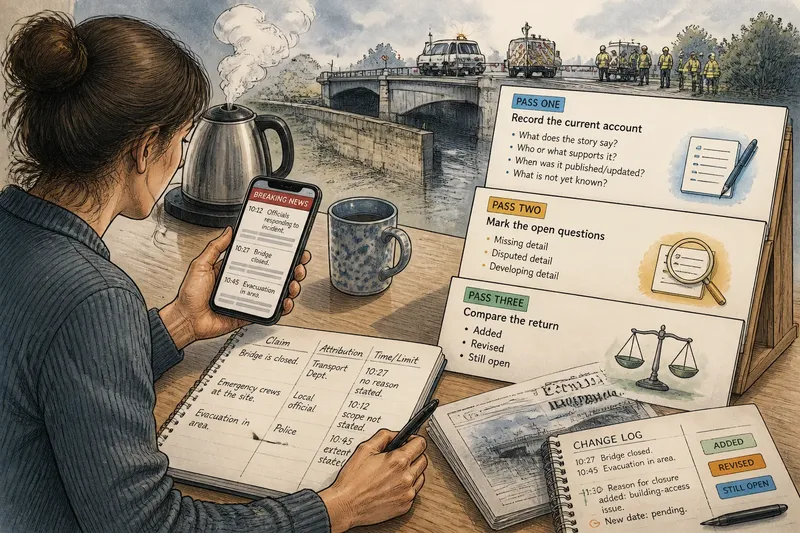
You open a breaking-news alert while waiting for the kettle to boil. The first update says officials are responding; a later post mentions an evacuation, and a social feed offers a cause. A three-pass routine for a developing story helps keep those statements in separate boxes: what the report says now, what remains unsettled, and what has changed when you check again.
The routine is useful because early coverage often arrives in fragments. A careful reader does not need to decide the whole story at once. The practical task is to keep a clear record of the report’s claims and limits, then revisit it when new information appears.
Pass One: Record the Current Account
Start with the article, broadcast transcript, or official update in front of you. Note the outlet, the time shown on the page, and the most recent update time if one is provided. Those details help distinguish a fresh revision from an older item still circulating in a feed.
Write down the central claims in plain language, keeping each one separate. “Emergency crews are at the site” and “the incident began after a vehicle struck a barrier” are different claims; one can be reported while the other remains unknown.
For each claim, note who is said to support it. The report might attribute a detail to a named agency, an eyewitness, a document, or an unnamed source. If the story gives no attribution, record that absence rather than filling it in yourself.
Use a small note on paper or in a notes app. Keep it factual and brief: “Report states that the station is closed; cause not stated.” Avoid converting a tentative phrase such as “officials are investigating” into a conclusion about what happened.
- Claim: What does the story explicitly say?
- Attribution: Who or what is given as the basis?
- Time: When was this version published or updated?
- Limit: What does the story say is not yet known?
Say you read an invented local update stating that a bridge is closed, with the transportation department cited for the closure and no explanation given. Your note would preserve those details without guessing at damage, danger, or reopening plans. The observable result is a compact record you can compare with the next version.
When Reading Goes Off Track?
Why does an early report feel complete?
A polished article can sound settled even when its information is limited. Clear writing describes what the newsroom knows; it does not necessarily mean every relevant fact has been established. Check the article’s specific qualifications and the time of its latest update before treating a smooth narrative as a finished account.
What if two outlets disagree?
First check whether they are discussing the same claim and the same time window. One may describe a confirmed closure while another repeats an earlier expectation about reopening; keep both statements attributed and note the difference rather than choosing a winner from tone alone.
How should a social post fit in?
Treat a post as a source of a claim, not automatic confirmation of the event it describes. Record who posted it, what direct basis is offered, and whether a news outlet or relevant organization has independently addressed that specific detail.
What if the update has no new facts?
That is still useful to know if you can identify what remains unchanged. Mark the time you checked and the questions still open, then decide whether another refresh is likely to add useful information or merely repeat the same account.
Pass Two: Mark the Open Questions
On the second pass, return to the claims you recorded and identify what the story has not established. Use precise labels such as “not stated,” “attributed but not independently confirmed in this report,” or “under investigation.” These descriptions are more useful than a broad note that the entire story is uncertain.
Separate three kinds of open questions. A missing detail is something the report does not supply, such as the time a service may resume. A disputed detail is one that sources describe differently. A developing detail is one that could be clarified as officials, witnesses, or records provide more information.
Do not treat silence as evidence for either side. If an article does not identify a cause, that does not establish that no cause is known; it only tells you that the article has not supplied one. Likewise, an official statement may answer a narrow operational question without settling broader questions about responsibility.
Use a short “still open” list. Keep it tied to the story rather than expanding into every conceivable possibility:
- Which reported details have a named source?
- Which claims are attributed without supporting material described?
- What question does the story explicitly leave unanswered?
- Are conflicting accounts about the same event, time, or location?
- What later information would actually resolve an open point?
That final question helps prevent a common detour: collecting more commentary that does not address the missing evidence. If the open issue is whether a road is accessible, a current transportation notice may answer it more directly than a stream of speculation about why it closed.
Pass Three: Compare the Return
When you revisit the story, do not reread it as if it were new. Open the same article or a clearly identified follow-up and compare its claims with your notes. Look for additions, corrections, changed attribution, and questions that remain unanswered.
A simple change log is enough. Use three labels: “added,” “revised,” and “still open.” Under “added,” record a new fact and its stated source. Under “revised,” note what wording or account changed. Under “still open,” carry forward only questions the update has not resolved.
Pay attention to the difference between a new detail and a stronger conclusion. An update may add a source without changing the claim, or it may revise the claim itself. If the account changes, preserve the earlier wording in your notes so you can see what shifted instead of remembering only the latest version.
For example, imagine an invented update first says a public meeting was postponed, with no reason supplied. A later notice says the postponement followed a building-access issue, while the meeting’s new date is still pending. Your comparison would mark the reason as added, the schedule as still open, and the original report as incomplete on that point—not as proof that it was wrong.
If the outlet labels a correction, read it closely and note what was corrected. A correction can affect one detail without overturning the rest of the report. If you see conflicting versions but no correction, keep the discrepancy visible and look for a later explanation rather than silently blending the accounts.
Keep a Useful Record
A running note should make your next check faster, not become a second article. Keep only the central claims, their attributions, the unresolved points, and meaningful changes. If the story develops over several updates, date each entry and avoid copying paragraphs that you will not compare.
Be selective about refreshes. If the report has not changed and no new relevant source has appeared, another check may add no clarity. Choose a reason to return, such as a scheduled briefing, a promised update, or the release of a document mentioned in the story.
Do not let a later, more confident version erase the path by which the account developed. Readers can mistake a revised story for a story that was always certain. A brief record of what was stated, what was open, and what changed preserves that distinction without requiring you to make a verdict before the evidence supports one.
For a developing story, read the current account, mark its open questions, and compare the next version against your notes. That three-pass routine keeps uncertainty specific: you can see which claim is supported, which is merely attributed, and which still needs an answer.
When you return to a developing story, keep the earlier note beside the new version; the change itself can be as informative as the latest detail.